


NASA looks for its next astronaut class
NASA has announced its next astronaut selection. Explore how astronaut training can span spacewalking, aircraft operations and lunar geology.
Read the source ↗Change a planet’s orbit, jump on the Moon and investigate the first minutes of the universe. Then plan your next night under the stars.

Meet Tira the space fox, Nova and Setra. Solve science quests together and optionally unlock 30 interactive labs with a family membership.
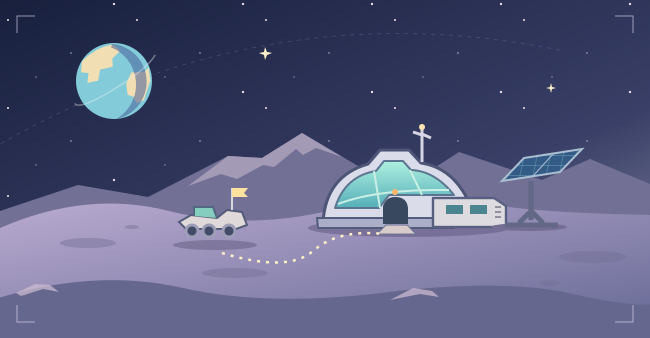
Visit the Family ClubThe station beacon has gone dark and Tira is stranded by a lunar crater. Take the controls and guide the fox home with four experiments.
Explore a dedicated interactive planetarium: find constellations and planets, change time and location, and navigate the sky freely.
Enter Sky Dome10 physics, 10 chemistry and 10 cosmic interactive simulations. Purchases permanently unlock experiments; free periods are temporary.
Loading experiments…
Choose a bench, make a prediction, then measure it for yourself.
The reference is a one-metre pendulum on Earth. Set up the second one.
Choose a prediction, then run the experiment.
This small-angle model uses a massless string and constant gravity, with no friction.
T ≈ 2π√(L/g)OpenStax · The Simple Pendulum ↗Follow the story back to the scientists who published it.
NASA has announced its next astronaut selection. Explore how astronaut training can span spacewalking, aircraft operations and lunar geology.
Read the source ↗ESA has released a view of the crowded central region of our galaxy from Euclid. Open the original image and compare how densely stars appear across the field.
Read the source ↗Messier 30 is about 27,500 light-years away in Capricornus. Images taken years apart let researchers follow tiny changes in the positions of its stars.
Read the source ↗Dates use Tehran time. For a clear view, find a dark spot away from city lights.
Before sunrise the two planets appear about 1.2 degrees apart, although they remain far from each other in space.
Try the early mornings of November 17 and 18 after moonset. A dark, clear sky offers a better chance of seeing a meteor.
Look for the full Moon on the evening of November 24. Sketch a few bright and dark markings to compare with your next observation.
The NASA Goddard table places the full phase at 04:58 Tehran time. On a nearby evening, look for the bright and dark regions on the Moon.
10 physics, 10 chemistry and 10 cosmic interactive simulations. Purchases permanently unlock experiments; free periods are temporary.
Loading experiments…